
- Why Knowing These Documents Matters for Property Title Research
- The 7 Essential Legal Documents for Property Title Research
- How to Read a Property Deed Like a Professional
- Understanding Property Liens and Encumbrances
- Your Property Title Search Checklist: Tracing the Chain of Title
- Digital vs. Physical Records: Where to Find the Documents
- DIY vs. Professional Title Search: Know the Risks
- Conclusion: Start Your Property Title Research Training
- Frequently Asked Questions
Last Updated: Sep 7, 2026
Property title research is the systematic examination of public records to verify a property's legal ownership and uncover any claims, liens, or defects attached to it. Whether you are buying a home or starting a career in title examination, knowing which documents matter can save you from costly surprises at the closing table. Below, we break down the essential legal documents for property title research and show you how to read them with confidence.
Why Knowing These Documents Matters for Property Title Research
Most first-time buyers assume the seller's deed is all that matters. In practice, property title research depends on a much wider paper trail that can include anything from divorce decrees to bankruptcy filings.
A title defect discovered late in the closing process can delay your move, trigger legal fees, or even void the sale entirely.
The 7 Essential Legal Documents for Property Title Research
Property title research relies on a core set of records that establish ownership and reveal any clouds on the title.
The Deed: Your Starting Point
The deed is the primary legal instrument that transfers ownership. Every property title search begins with the most recent deed and works backward. Look for the grantor (seller) and grantee (buyer) names, a full legal description, and the grantor's signature. A deed missing proper execution or notarization can invalidate the transfer.
The Promissory Note and Deed of Trust
When a property is financed, the promissory note documents the borrower's promise to repay the loan. The deed of trust, common in many states, secures that note by giving a trustee the power to foreclose if payments stop. An unsatisfied deed of trust remains a lien on the property even after the owner sells.
Tax Records, Judgments, and More
Beyond the core documents, thorough property title research requires checking property tax records for unpaid assessments and searching for judgment liens from lawsuits. Bankruptcy, divorce, and probate filings can all affect ownership rights.
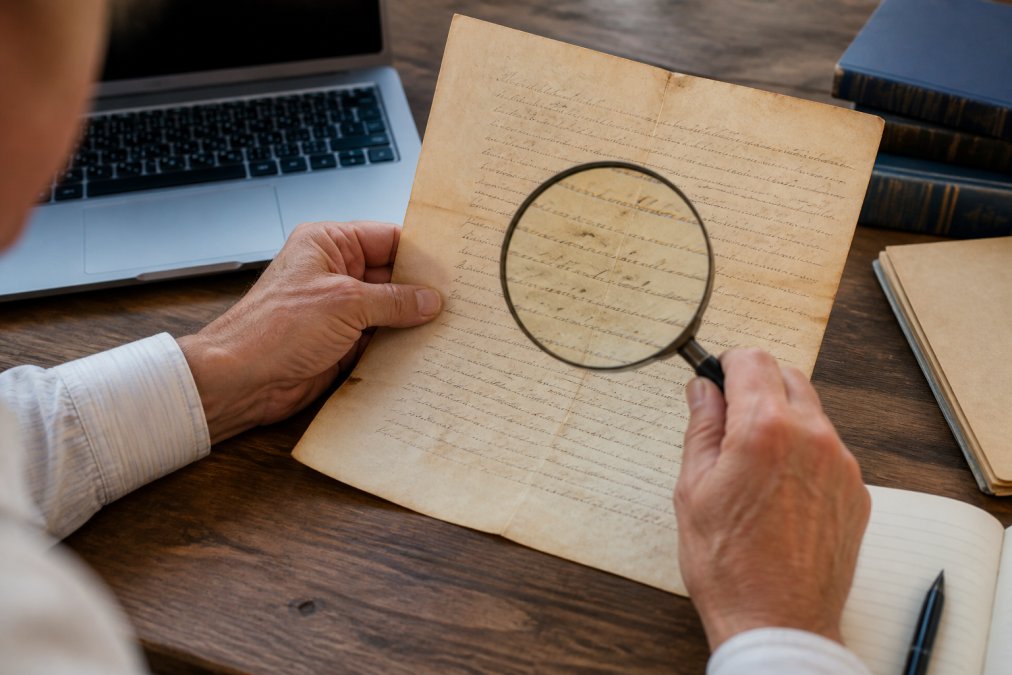
A researcher's hands holding an old, official property deed document with a magnifying glass over the legal text, on a wooden desk with a laptop nearby
How to Read a Property Deed Like a Professional
Reading a deed is not about skimming the first page. The critical details sit in the legal description and the granting clause.
The Caption and Premises
The top of the deed identifies the state and county and the recording information. The premises clause names the grantor and grantee. Verify these names match the prior deed exactly, a mismatch, such as a middle initial added or omitted, can create a break in the chain requiring a corrective affidavit.
The Legal Description
This is the most scrutinized section. The legal description uses one of three systems: metes and bounds, the Public Land Survey System (PLSS) with township and range, or a lot and block reference from a recorded plat. Cross-check it against county land records to ensure it matches prior deeds. A discrepancy can indicate a boundary dispute or an error in an earlier conveyance. Pay particular attention to the “point of beginning” in a metes and bounds description, if wrong, the entire parcel boundary shifts.
The Granting Clause and Habendum
The granting clause contains the words of conveyance, such as “grant, bargain, and sell.” The habendum clause typically follows, stating that the grantee holds the property “to have and to hold” it. In a warranty deed, the grantor covenants they hold clear title and will defend it. In a quitclaim deed, there are no such covenants, the grantor transfers only whatever interest they have.
Exceptions and Reservations
Many deeds exclude prior easements, mineral rights, or restrictive covenants that survive the transfer. These appear in the exceptions clause. A deed that reserves mineral rights to the grantor means the new owner holds surface rights only. Review each exception carefully, an unexamined exception can mean a third party has legal access to part of the property.
Execution and Acknowledgment
The grantor's signature must match the name on the previous deed, and a missing spousal signature can create a cloud on title. In most states, the grantor must sign before a notary public, who affixes their seal and acknowledgment. A deed lacking proper notarization is typically not recordable and may not give constructive notice to later purchasers.
Watch OutSkipping the legal description cross-check is the most common mistake beginners make in property title research. If the description does not match county land records, the deed may not describe the same parcel, and the entire search can be invalidated.Recording Data
The final section shows the book and page number or instrument number assigned by the county recorder, confirming the deed was officially entered into the public record. The recording date establishes priority under the state's recording statute, whether race, notice, or race-notice. This is why recording data is the legal backbone of the chain of title.
Understanding Property Liens and Encumbrances
Liens and encumbrances are claims against the property that reduce its value or restrict its use. An encumbrance does not prevent a sale, but it transfers with the property. Property title research must distinguish between several types of claims and understand how they attach, how they are prioritized, and where to find them.
Mortgage Liens and Deeds of Trust
A mortgage lien gives the lender a security interest until the loan is repaid. In some states, the borrower holds title and the lender holds a lien. In others, the lender holds title until the loan is satisfied. When a property is sold, the existing mortgage lien must be satisfied and released. An unsatisfied deed of trust remains a lien even after the owner sells, a common title defect.
Judgment Liens and Their Priority
A judgment lien results from a court ruling against the owner. When a plaintiff wins a lawsuit, the judgment becomes a lien on the defendant's real property in the county where it is recorded. Judgment liens typically attach to all property the debtor owns in that county, with priority dating from the recording date. Federal tax liens generally take priority over later-filed state judgment liens. Searching requires checking county court records and federal district court records.
Tax Liens and Tax Sales
A tax lien arises from unpaid federal, state, or local taxes. Property tax liens are typically superior to all other liens except prior federal tax liens (irs.gov). When property taxes go unpaid, the county may conduct a tax deed sale (where the buyer receives title directly) or a tax lien certificate sale (where the buyer receives the right to collect delinquent taxes plus interest). A title search must check the county tax assessor's records for current-year taxes and the treasurer's records for delinquent tax certificates.
Easements and Restrictions
Easements grant someone else the right to use part of the property, such as a utility company accessing power lines or a neighbor using a driveway. Easements can be express, implied, or prescriptive. A recorded easement appears in county land records and is typically referenced in the deed's exceptions clause. Restrictions, such as homeowners association covenants, conditions, and restrictions (CC&Rs), limit how the property can be used and appear in the subdivision plat or a separate recorded declaration.
Bankruptcy and Probate Filings
Bankruptcy filings create an automatic stay that halts collection actions, including foreclosure. A title search must check federal bankruptcy court records for active or recently dismissed cases. A discharge releases the debtor from personal liability but does not automatically remove a valid lien, the lien survives unless the court voids it. Probate filings matter when an owner dies; a deed from an executor has different legal requirements, and a title search must verify the executor had authority to sell under the will or state intestacy laws.
| Document Type | What It Does | Where to Find It | Priority Consideration |
|---|---|---|---|
| Mortgage / Deed of Trust | Secures a loan with the property | County land records | Records first in time generally has priority |
| Judgment Lien | Attaches property for unpaid court judgments | County court records, federal district court | Dates from recording; federal tax liens may supersede |
| Property Tax Lien | Secures unpaid property taxes | County tax assessor / treasurer | Typically superior to most other liens |
| Federal Tax Lien | Secures unpaid federal taxes | County recorder (Notice of Federal Tax Lien) | Generally superior to later state liens |
| Easement | Grants usage rights to third parties | County land records | Runs with the land; binding on successors |
| CC&Rs | Restrict property use | County land records (subdivision plat or declaration) | Runs with the land; enforceable by HOA |
| Bankruptcy Filing | Triggers automatic stay; may discharge debts | Federal bankruptcy court (PACER system) | Discharge does not automatically void liens |
State-Specific Nuances in Lien Law
Lien law varies by state. Lien law varies by state. In some states, an attorney must conduct the closing and title examination. In others, a title company or escrow agent manages the transaction. Some states require a title insurance commitment before closing; others operate a state-run title guaranty fund. Understanding your state's system determines which documents you must examine and which professionals you must involve.
Your Property Title Search Checklist: Tracing the Chain of Title
A property title search checklist keeps you organized when tracing the chain of title. Professionals typically look back 30 to 50 years, though lenders may require a deeper examination.
- Obtain the current deed from public records and note the grantor and grantee.
- Search the grantor-grantee index for all conveyances involving the property.
- Trace each prior transfer backward, verifying that every deed was properly recorded.
- Check for liens and judgments against each prior owner during their ownership period.
- Review tax records for unpaid assessments or tax sales.
- Search for easements and restrictions that may limit property use.
- Examine foreclosure history to confirm all proceedings were legally completed.
Each step builds on the last. A gap in the chain of title, where no recorded deed connects one owner to the next, is a red flag requiring immediate attention.
Digital vs. Physical Records: Where to Find the Documents
County land records have moved online in most jurisdictions, but the transition is uneven. Some counties offer full digital access, while others still require in-person visits for older records.
Digital access is faster but has limits. Scanned documents from the 1980s may be illegible, and indexing errors can hide records. Physical records are authoritative but require travel and time. Professionals often use a hybrid approach: starting with online indexes, then confirming critical records against original filings.
Recording statutes vary, and some states use systems that prioritize the first party to record without notice of prior claims. Understanding your state's rules affects how you interpret the chain of title.
DIY vs. Professional Title Search: Know the Risks
Trying property title research yourself can save money, but the risks are real. Missing a single recorded lien or misreading a legal description can leave you financially exposed. The Consumer Financial Protection Bureau's guide on title insurance explains why lenders require a professional title search before closing.
DIY searches work best for simple transactions with recent, well-documented ownership history. They fail when prior owners have common names, when properties have been subdivided, or when foreclosure and bankruptcy records complicate the chain. Professional title examiners carry errors and omissions insurance.
For career changers, the professional route offers a different kind of security. Learning how to read a property deed and trace a chain of title is a marketable skill. According to the Bureau of Labor Statistics occupational outlook for title examiners, demand for these roles remains steady because every real estate transaction requires title verification.
Conclusion: Start Your Property Title Research Training
Property title research is a discipline built on documents, and mastering the essential legal documents for property title research is the first step toward protecting yourself or building a new career. The payoff is a flexible, in-demand skill that works from home.
At Learn Title Searching, our training is built on over 40 years of industry experience and led by an expert who authored the industry's leading manual. You get real-world title search training with personal instructor support, learning at your own pace. Get started with Learn Title Searching and master property title research today.
Frequently Asked Questions
What is the 3-3-3 rule in real estate?
The 3-3-3 rule is a guideline for homebuyers, not a legal requirement for title research. It suggests you should be able to afford a home that is roughly three times your annual household income, have a 20% down payment, and secure a mortgage with a payment no more than 3% above the current average rate. In property title research, this rule is not a factor. Your focus is on examining legal documents like deeds and liens to verify ownership.
What documents does a title company need to start a search?
To begin a property title search, a title company or researcher needs the property's legal description, which is often found on the current deed or tax assessment records. The property's street address and parcel number are also essential. Having a copy of the most recent deed, known as the vesting deed, speeds up the process considerably. From there, a professional will trace the chain of title back through historical records.
How far back should a property title search go?
The standard practice is to search the chain of title back at least 50 years, but many professionals recommend going back to the original land grant or patent. This is often called a '60-year search' in some states. The goal is to find any breaks in the chain, unresolved liens, or defects that could cloud the title. A longer history provides a clearer picture, but the specific requirement can vary based on state law and the lender's guidelines.
What is the difference between a warranty deed and a quitclaim deed in title research?
In title research, this distinction is critical. A warranty deed guarantees the grantor holds clear title and has the right to sell the property, promising to defend the title against any claims. A quitclaim deed transfers only whatever interest the grantor currently has, without any warranties. If a property was transferred via quitclaim, it can signal a potential title defect or a break in the chain of title that warrants deeper investigation.
Enroll Now
0 Comments