
Steps to Research Property Ownership and Find the Owner
WSWilliam Stephen· Author/Instructor
Last Updated: Nov 16, 2026
Quick Summary
To research property ownership, start with the full street address and county name, then pull the current assessor record to identify the owner of record. From there, search the county clerk and recorder's index for deeds and trace the chain of title backward.
- Property records live at the county level, so confirm the county before searching.
- The assessor shows the current owner; the recorder holds deeds and ownership history.
- Copy owner names exactly as shown, including TR, TRUSTEE, LLC, or INC.
- Work the chain of title backward, linking each grantor to a prior grantee.
- Match parcel numbers and legal descriptions to confirm records describe the same property.
Want to research property ownership like a pro?Learn Title Searching trains you in real-world title research with expert guidance and personal support.
Start Title Search Training
Table of Contents
- Step 1: Gather What You Already Know Before You Search
- Step 2: How to Search Property Records by Address
- Step 3: How to Find Out Who Owns a Property Right Now
- Step 4: How to Get a Copy of a Property Deed Online
- Step 5: Run a Property Ownership History Search and Trace the Chain of Title
- Step 6: Verify Records Refer to the Same Property
- Step 7: Handle Trusts, LLCs, Estates, and Incomplete Records
- Build Real Research Skills With Guided Title Search Training
- Frequently Asked Questions
Step 1: Gather What You Already Know Before You Search
You can't research property ownership step by step without a starting point. The more you bring to the search, the faster it goes. Beginners often waste hours when they type a name into a county portal with nothing else to match it against.
Collect these details first:
- Full street address, including unit or lot number
- Owner name as it appears on tax bills
- Parcel number or APN, if you have it
- Legal description from any deed or survey you own
- County name, since records live at the county level
Write them down. Keep them in one place.
A common mistake is skipping the county. Property records are held by local government offices, not a single national database. Get the county wrong and every search after that fails.
Step 2: How to Search Property Records by Address
The fastest way to search property records by address is through the county assessor's online portal. Many counties publish a free search tool where you can enter a street address to look up parcel and owner information.
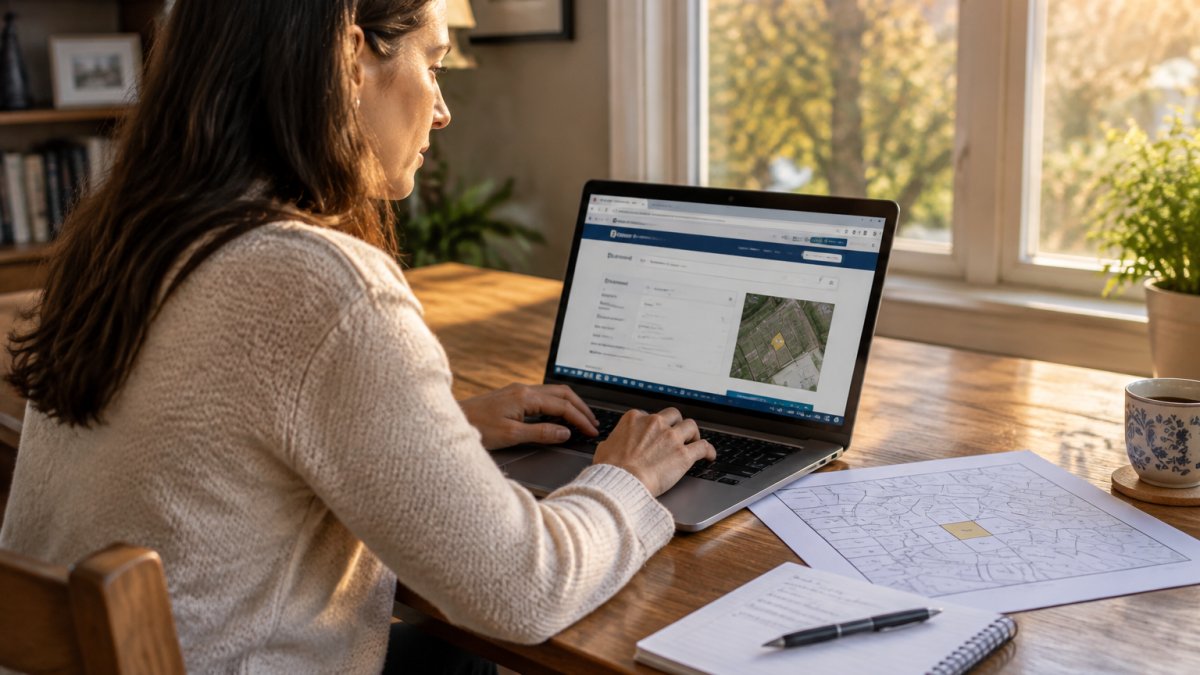
Woman using a laptop to research property ownership on a county website with a parcel map nearby.
Start with a simple web search: "[county name] property search" or "[county name] assessor". The official site usually ends in .gov or .us. Bookmark it.
Assessor Portals vs. Clerk and Recorder Searches
These two offices hold different records, and you need both.
| Office | What It Holds | Best For |
|---|---|---|
| Assessor | Parcel data, owner name, tax value | Current owner, property details |
| Clerk and Recorder | Deeds, liens, recorded documents | Ownership history, transfers |
The assessor tells you who owns the property now. The recorder tells you how they got it. Start with the assessor, then move to the recorder for the paper trail.
Step 3: How to Find Out Who Owns a Property Right Now
To find out who owns a property right now, pull the current assessor record for that parcel. The owner name listed there is the party the county bills for property tax, which is the closest thing to an official current owner.
Learn how to do a Real Estate Title Search
William Stephen
Look for the "owner of record" field. It may list one person, a married couple, a trust, or a company. Note the exact spelling and any co-owners.
Reading the Owner Name on Assessor Records
Assessor names are often abbreviated or reformatted. "SMITH JOHN A & MARY" means two owners. A name followed by "TR" or "TRUSTEE" signals a trust. An LLC or INC means a business entity holds title.
Copy the name exactly as shown. You'll need it to search deed records in the next steps.
Step 4: How to Get a Copy of a Property Deed Online
You can get a copy of a property deed online through the county clerk and recorder's search portal. Many county recorder offices let you search by grantor, grantee, or parcel number, and some offer copies online.
Here's the workflow:
- Open the county recorder's official search page
- Choose "grantor/grantee" or "name" search
- Enter the owner name from the assessor record
- Filter results by recording date
- Open the deed and confirm the legal description matches
- Download or request a certified copy
Watch out: some counties only offer an index online and require an in-person or mail request for the actual document image. Call ahead before you make the trip.
Step 5: Run a Property Ownership History Search and Trace the Chain of Title
A property ownership history search means working backward through recorded deeds to build the chain of title. Each deed names a grantor (the seller or transferor) and a grantee (the buyer or transferee). Link them in order and you have the ownership timeline.
Start with the most recent deed. Note the grantor, grantee, and recording date. Then search for the deed where that grantor was the grantee. Repeat until the chain reaches the earliest recorded transfer or the point where the county's index begins.
Reading a Deed Line by Line
Most deeds are short, but the fields that matter are easy to skim past. Open the document image and pull these out in order:
- Grantor and grantee, spelled exactly as recorded, including middle initials and suffixes
- Recording date and instrument number, which is how the clerk indexes the document
- Legal description, usually a lot and block in a platted subdivision or a metes-and-bounds narrative in rural areas
- Transfer type, such as warranty deed, quitclaim deed, trustee's deed, or executor's deed
- Consideration, which may be stated as a dollar figure or as "for valuable consideration" with no amount
- Exceptions and reservations, which can carve out easements or mineral rights
The transfer type tells you a lot. A warranty deed is the standard arm's-length sale. A quitclaim deed transfers whatever interest the grantor has, with no promises, and often shows up in family transfers or cleanups. A trustee's deed usually means a trust was involved. An executor's deed points to a probate estate.
Following the Chain Backward
Work in reverse. The current owner is the grantee on the most recent deed. That same person or entity should appear as the grantor on the deed before it, and so on.
A common pattern is a chain that runs through an estate: the owner dies, the property passes by will or intestacy, and an executor or heir later deeds it out.
Watch out: a gap where one grantor never appears as a prior grantee is a red flag.
When the Chain Runs Through an Entity
If a deed names an LLC, corporation, or trust as grantee, the chain does not stop there. Search the entity name as grantor in later deeds to see how it eventually transferred the property out. For an LLC, the state business registry will show formation date, registered agent, and status, which helps you confirm the entity existed at the time of the transfer. For a trust, look for a recorded memorandum or trustee's deed that names the trustee. The people behind the entity are usually found in those documents, not in the deed itself.
Step 6: Verify Records Refer to the Same Property
Never assume two records with the same address describe the same parcel. Verify by matching the legal description and parcel number across every document. Addresses get renumbered, split, and merged over time.
Use this checklist:
- Parcel number matches on assessor and deed records
- Legal description (lot, block, subdivision) is identical
- Owner names link grantor to grantee in sequence
- Recording dates move forward logically
- No unexplained gaps in the chain
If any box stays unchecked, keep searching before you trust the result.
Step 7: Handle Trusts, LLCs, Estates, and Incomplete Records
Complex ownership is common, and it's where most DIY researchers get stuck. A trust, LLC, or estate hides the real people behind a name, so you have to trace the entity itself. This section walks through each case and then covers what to do when the online record simply isn't there.
Trusts
When the assessor record shows a name followed by "TR" or "TRUSTEE," the property is held in trust. Search the recorder's index for the trustee's name as grantor and grantee, and look for a recorded memorandum of trust or trustee's deed. Those documents usually name the trust, the trustee, and sometimes the beneficiaries. The trust agreement itself is often not recorded, so the deed and memorandum are your best public trail.
LLCs and Corporations
An LLC or INC on the assessor record means a business entity holds title. Pull the entity's record from the state business registry, which typically shows formation date, registered agent, principal address, and current status. Then search the recorder's index for the entity name as grantor to see when and to whom it transferred the property. Members and managers are not always listed in the registry, so the deed and any recorded operating agreement excerpts may be the only public clues.
Estates and Probate
An executor's deed or a deed from an heir signals a probate transfer. Check the county court where the decedent lived for probate filings, which usually name the executor or personal representative and list the real property. The probate case number is a useful cross-reference when the recorder's index is ambiguous.
When Online Records Are Incomplete or Unavailable
Many counties digitized only recent decades. Older deeds may exist only on microfilm, in bound books, or in an off-site archive. When the online index returns nothing, try these steps in order:
- Search a wider date range. Indexes sometimes have gaps around annexations, renumbering, or system migrations.
- Search by parcel number instead of name. Parcel-based indexes survive name changes and misspellings.
- Call the recorder's office. Staff can confirm whether a document exists but isn't digitized, and they can tell you the correct index to search.
- Request a copy in writing. Most offices accept a written request by mail or through an online form that identifies the instrument number or the parties and approximate date.
- Check neighboring counties. Boundary parcels and split lots sometimes appear in an adjacent county's records.
When you contact an office, bring the parcel number, the legal description, the owner name as recorded, and the approximate date range. That combination lets staff find the document even when the name is misspelled in the index.
Watch out: public-record availability varies by county and by era, and records can be outdated between the date of a transfer and the date the assessor updates ownership.
Build Real Research Skills With Guided Title Search Training
Reading records is one skill. That second skill is what title professionals get paid for, and it's what we teach at Learn Title Searching.
Our courses draw on 40+ years in the title industry, led by an instructor who authored the leading training manual.
Researching property ownership by hand teaches you the basics. Doing it professionally, accurately, and fast takes structured training.
Frequently Asked Questions
What's the easiest way to find out who owns a property?
Start with the county assessor or property appraiser website for the county where the property sits. Search by address or parcel number to see the owner name on the tax roll. That gives you the current owner of record, but it does not confirm clear title. For a fuller picture, pull the deed from the county clerk or recorder and check the property ownership history for liens, transfers, and encumbrances. The assessor is the fast starting point; the recorder is where you verify.
Can I research property ownership myself without hiring a title company?
Yes. Most county records are public, and you can search assessor databases, clerk and recorder indexes, and deed records yourself. The work is in knowing which office holds which record, how to verify that documents refer to the same parcel, and how to read a deed's grantor, grantee, and legal description. A structured step-by-step process gets you accurate results.
How do I search for a deed by property address?
Go to your county clerk or recorder of deeds website and use the address or parcel number search if available. Many counties index by grantor/grantee name and parcel number rather than street address, so pull the parcel number from the assessor first. Then open the recorded documents list, locate the deed, and request a copy. Recording date and instrument number help you confirm you have the right document for that property.
What should I do if the online records are incomplete?
Call or visit the county clerk or recorder's office and request a manual search of the index. Older documents are often not digitized, and some counties only post records after a certain date. Ask for the deed, any liens, and the prior transfer. If the chain of title has gaps, note them and follow up with the office. Learning to work with incomplete records is a core skill in property ownership research and title searching.
0 Comments